
The days of Competition and Profit-At-All-Cost Mindsets are starting to close in favor of more Mindful Organizations that harness the incredible abilities of every employee.

This is the beginning of a series sharing the 2024 Teal Landscape Report. You can access the Report itself, and all of the series links in subsequent posts. You can access the complete Report here.
The organizations you see in this picture are one page of the 2024 Teal Landscape Report created by The Teal Team and Human First Works, to help us understand the newest working paradigm in Business.
If you look closely at these organizations, you’ll probably know many famous MNOs and corporations on this list already. These companies have already been verified as incorporating some Teal practices inside their organizations.

Amazon has recently been added to the list of orgs flattening their middle management levels — read about this in this Fortune’s article from March 2025. Middle management flattening is a sure sign that the organization is becoming Teal.
For people who may not know about Teal, it is cropping up in something called “The Great Flattening” in the US. If you didn’t know better, you might think that the United States was the only country experiencing this phenomenon, but as you’ll see later in the report, the US has been slower to experience all of Teal tenets, yet has been subject to the Flattening aspect of it as its European counterparts experience a more fully-rounded implementation of Teal with much more of its core tenets intact.
To be clear, Teal tenets fit together, yet organizations can choose one, two or all three of its tenets to be called “Teal Organizations.”
You’re not alone if you’ve never heard of Teal Paradigm Organizations or Teal principles. However, it’s something that literally millions of people around the world have already read about, millions of employees already participate in, and many of the organizations these people work in are already on their own Teal journeys.
I’d written about Teal organizations on LinkedIn in September 2024, leading up to the 10th Anniversary Celebration of Frederic Laloux’s book, Reinventing Organizations, in October 2024.
As background: A business book selling 10,000 copies throughout its lifetime is seen as a success, however, Laloux’s book is seen as a mega-success. A former McKinsey consultant, Laloux wrote his self-published book after three years of intense research.
With no PR, the book had sold over 1 million copies worldwide by the time we celebrated its 10th anniversary in October 2024, and has been voluntarily translated into 19+ languages, in just this first 10-year period alone; its lifetime is yet to be seen. Many consider it one of the last decade’s most influential business management books.
Listen to Laloux explain Teal in this 8-minute video: Sense and Respond, Frederic Laloux on a New Management Paradigm
In working with The Teal Team and Human First Works, my posts are meant to help people, and especially those in leadership, understand:
1) What Teal organizations are,
2) what makes them different from what we experience in today’s businesses, and
3) how your organization might already BE one of them, without even knowing it — and how the movement can support your business growth and change our world.
As explained in Laloux’s book, Teal principles redefine what it means to be in business today; organizations that serve a higher purpose beyond mere profitability as their primary goal. Organizations can take the shape of NGOs, for-profits, nonprofits, MNCs, education systems, or governments. We have evidence that Teal principles exist in organizations in every form.

They may have one or more of the following attributes:
- Self-Managed Teams. People in Teal businesses may work in small, self-managed teams of 10–12 people each, even if the whole organization has 100,000+ employees. [You can read about Bayer Pharmaceutical’s (Germany) Teal journey in the report — Bayer has approximately 99,700 employees].
- Employee Wholeness. Employees are encouraged to be themselves at work; no need for corporate masks to hide behind. Each person feels comfortable and empowered to bring their full selves to work. This encompasses their mental, emotional, physical, and spiritual well-being without fear of judgment. They are encouraged to be authentic while fully engaging in their roles. This creates a culture where everyone can thrive as themselves while feeling valued for their contributions.
- Organizational Evolutionary Purpose. The organization understands where it wants to go. All employees are encouraged to “listen” for the organization’s thoughts about what it might want to become or do, or add to its service or product lines. If you are a leader in your organization, you may have experienced this at some point if your business has made pivots after some delays in moving forward. Within the pivots lies your organization’s evolutionary purpose.
But Teal hardly stands alone in its concepts. Instead, it is a “folding-in” of many concepts whose time seems right and ready to change the charge of “profit at all costs.” It can be thought of as a Consciousness Mindset for Business. Teal organizations combine many mindfulness and humanitarian concepts from multiple decades of humanity and business growth:
- Abraham Maslow’s Hierarchy of Needs
- Jean Gebser’s Structures of Consciousness
- Clare Graves’, Don Beck’s, and Chris Cowan’s Spiral Dynamics (in multiple forms)
- Robert Kegan’s Constructive Developmental Theory
- Gary Hamel’s and Michele Zanini’s Humanocracy (2020)
- Conscious Capitalism
- Otto Scharmer’s Theory U
- Ken Wilber’s Integral Theory
- The emergence of B Corporations
- Corporate Social Responsibility (CSR)
- Environmental, Social and Governance (ESG)
- 2BL (“Double Bottom Lines” = usually Profit and People, or Profit and Planet Bottom Lines)
- 3BL (“Triple Bottom Lines” = usually Profit, People and Planet Bottom Lines)
- 4BL (“Quadruple Bottom Lines” = People, Planet, Purpose and Profit Bottom Lines)
- Vanessa Andreotti’s book and concepts in Hospicing Modernity
- The emergence of additional global movements that aid society as a whole. For a look at just one of these movements, take a look at the Upcycled Food Movement (for more on this, see Sue Marshall’s and her company, NETZRO’s profiles on LinkedIn)
- The Mindfulness Movement (for a good look at this, check out Derek Hill’s company, Waking Waves’ posts)
So, let me introduce you to the 2024 Teal Landscape Report, published in October 2024 by The Teal Team and Human First Works. I’ll share more on this in the coming articles, where we’ll dive into key information, highlights, and metrics on specific pages of the Report. (You can get your copy of the Report from the Dropbox link above.)
For now, my purpose is to help us understand how business organizational paradigms are evolving worldwide.
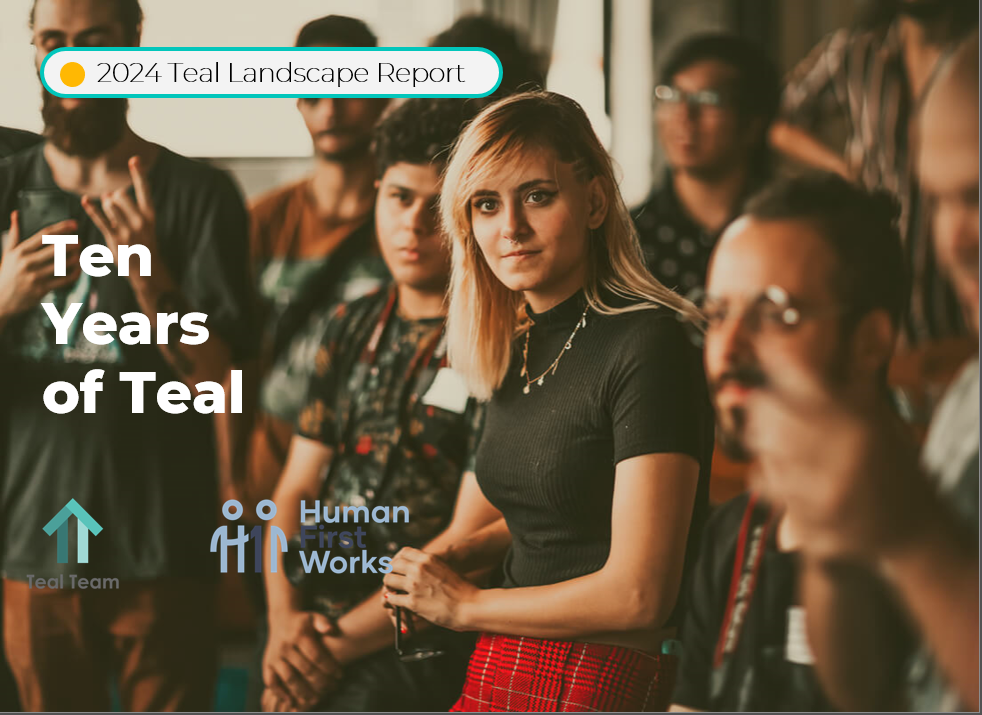
We are at a turning point in business. We have been experiencing Teal organizations in one form or another for over 40 years. But no one, until Laloux, consolidated and brought the changes into focus with his book until 2014, and now, 10 years later, the concepts have grown into a Movement.
We anticipate the new 2025 Teal Landscape Report to be issued during Fall 2025.
Thanks for reading and accompanying me in this journey toward a more fulfilling type of business paradigm!