
This series was originally published on LinkedIn and Medium, in which we started to define the term “Teaming Behaviors,” which is in direct opposition to “Team Building.”
This is a new concept in Teaming that creates high-functioning, adept, and transformational team success. Teams that have good Teaming Behaviors don’t get stuck in the weeds and go on to become highly exceptional and mature teams. These team members can then transition back and forth between other teams, infusing them with the same teaming skills to achieve true teaming success.
For the previous posts in the series, click here:
- Intro to Teaming Behaviors – Post 1
- Teaming Behaviors – Post 2: The Year They Discovered People – The Hawthorne Studies (1924-1932)
In the last post, we saw that the concept of studying teams only started in 1924, a century ago. The ideas of “teams” in these instances hadn’t even really been thought about before then. There was no study of “teams” of people before the Hawthorne Studies, which happened by accident.
Out of all my articles on Medium, this article has continued to receive the most views, every week, for over a year. To me, this means we are still grappling with the concepts of building exceptional teams and incorporating this knowledge within our teams at work.
The next era of study took place 33 years from the time of the Hawthorne Studies.
Many of us have heard of Tuckman’s Stages of Group Development or know Tuckman’s theory of the linear development of teams, which uses these stages—Forming, Storming, Norming, and Performing—to show how teams may develop as they work together.
Feel free to download the infographic in this post to study his model.
Dr. Bruce Tuckman was an American psychologist who analyzed a number of studies about teams and how they worked together. Contrary to popular belief, Tuckman never studied individual teams, but used a meta-analysis approach to research and understand general concepts about group development.
Tuckman’s initial study analyzed 61 separate white paper publications on team development published over a 32-year period; 92% of these were written and published between 1948 and 1964.
From his study and categorizations, he came up with some broad theories of how teams worked together. He published these findings in his 1965 white paper entitled “Developmental Sequence in Small Groups,” through which he discussed his consolidating theory of the Stages of Group Development, consisting of the Forming, Storming, Norming, and Performing Phases of Group Development.
In 1977, Tuckman and one of his doctoral students, Mary Ann Conover Jensen, re-examined 22 of these studies to directly test his 1965 hypotheses. The outcome of this review resulted in an additional white paper outlining a 5th stage of Group Development that Dr. Tuckman had initially failed to identify, but which existed nonetheless: the Adjourning/Mourning Stage.
Dr. Tuckman observed and charted the changes on both axes.
The teams’ maturity levels followed a defined path based on the behaviors displayed inside each of the stages. These, then, had outcomes congruent with their effectiveness levels relative to one another, rising or falling in their success levels as the teams worked together throughout all of the stages of their projects.
Team Effectiveness was determined in two primary realms: 1) Interpersonal Relationships, and 2) Task Accomplishment of the teams.
Since the team members’ relationships and the accomplishment of their tasks influenced the team’s effectiveness, the stage was set for the initial comparisons.
Take a look at the stages and think about your main team. Where might your team land in its stage of maturity?
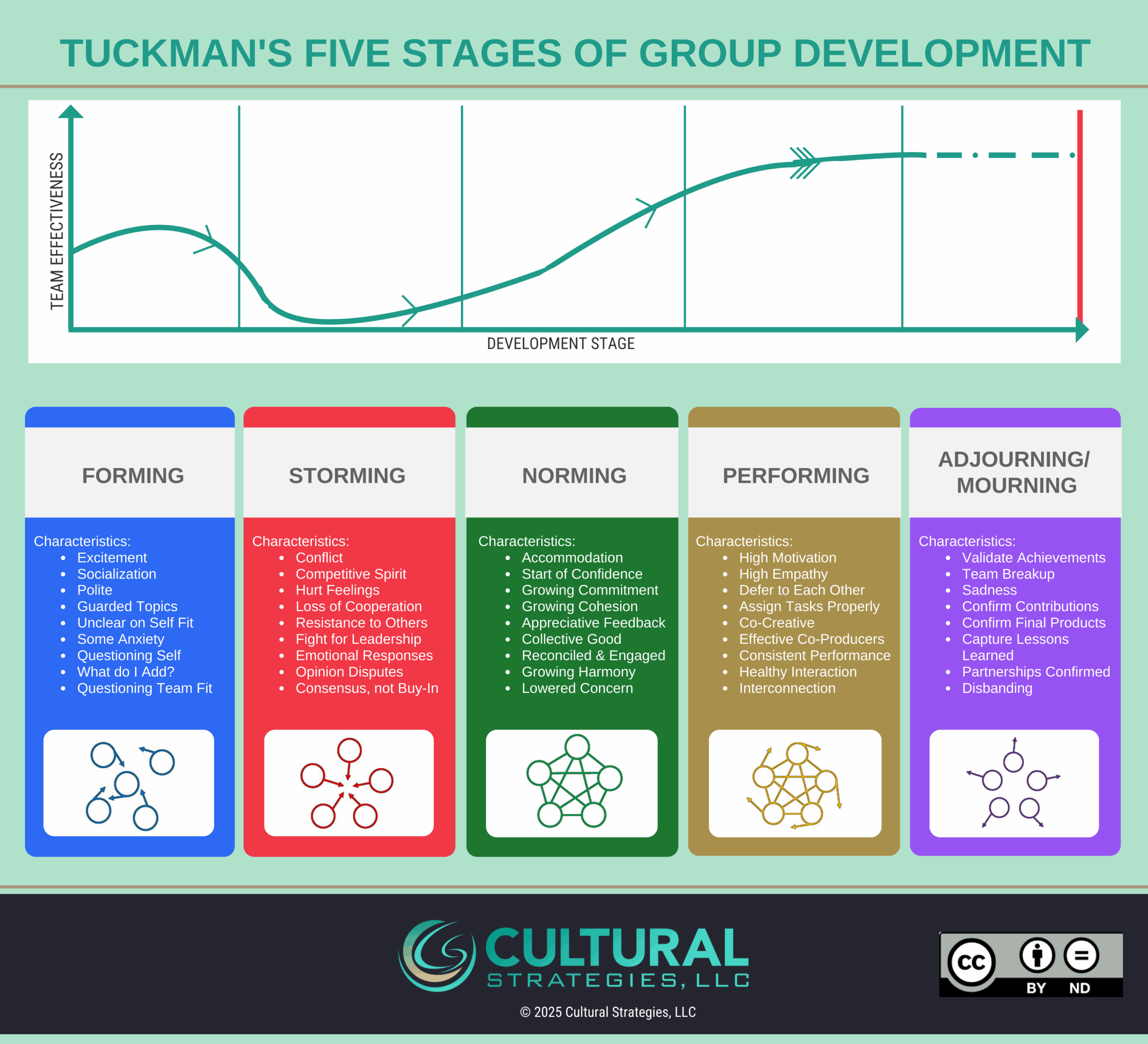
Next, we’ll examine the stages and their characteristics to understand their effectiveness levels.
We’ll also start to think about problems related to Tuckman’s Model.