
This is the 2nd in a series on Teal Organizational Paradigm. Click here to access the first story in this series, entitled “Introduction to Teal Business.”
The series is a primer, teaching the aspects of Teal business as discussed in Frederick Laloux’s book, Reinventing Organizations, showing how its concepts are changing how the world conducts business over
In preparation for releasing the 2025 Teal Landscape Report, which will come out in Fall 2025, we offer these looks into the Global Movement Teal has become.
Feel free to download and read The Teal Team’s and Human First Works’ 2024 Teal Landscape Report, which was the impetus for this series. I want to help others who have never heard of Teal Organizations understand them and the significant changes they are making in how organizations are run today, and hopefully, how organizations will be run in the future.
Prepping for Deeper Dives
To understand Teal Business, we need to understand the concepts that brought us here and how organizations have evolved over the last millennia and decades.
So much of what you don’t like about your current job has nothing to do with your job, your co-workers or your bosses. It has more to do with how the structures and paradigm thinking of existing business models have evolved, which may no longer fit how we want to work.
Throughout history, there have been pivotal moments that shifted how we saw ourselves — and how we worked. These turning points didn’t just expand our knowledge; they redefined the very nature of work itself.
But, before we can truly grasp a new way of doing business, we need a foundational knowledge of where we are now, and reflect on the beliefs from the past that shaped how we work. We have outgrown many of these beliefs — they no longer serve us. It’s time to make space for the next generation of business models.
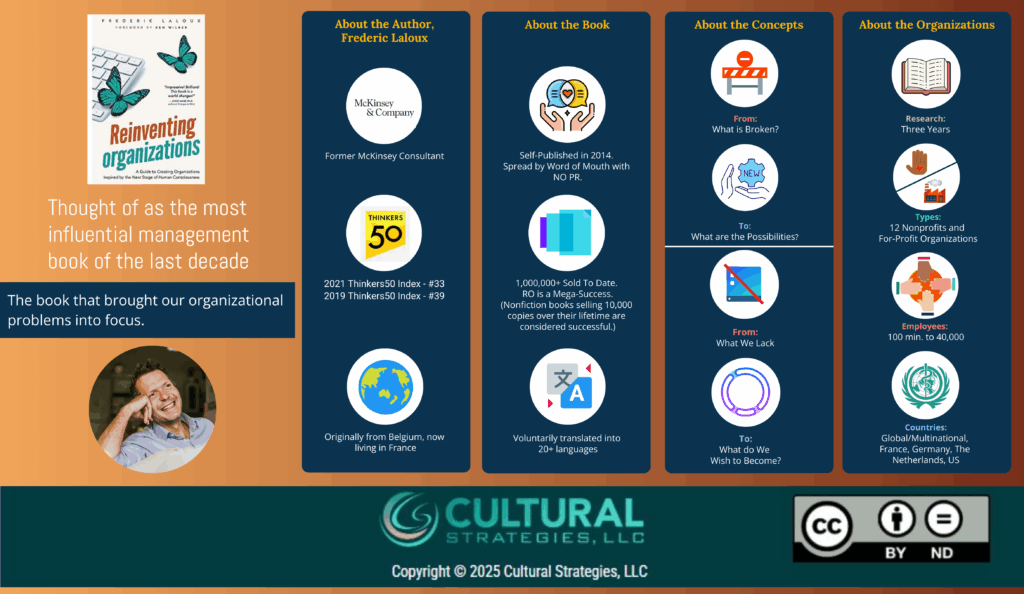
Unless you’ve already read Reinventing Organizations, most of what I will say in these articles will seem a bit foreign to you.
That’s why I’m writing these articles: we need to discuss and study the implications of what we’re experiencing in business, and look at the newer model emerging worldwide, which fits us better as Gen Xs, Millennials, Gen Zs, and our newer generations to come. Even though I’m a Boomer (dang!), I’ve seen the need for this model forever in my 50+ years of work life. I’m committed to the change and to you, as fellow human beings who may have been maligned during your years in our older models.
Laloux’s book outlines our iterative working models in business and color-codes them to help us understand them better. This allows us to compare and contrast models. In this way, we can see the forward movement of what we’ve needed and the refinements that got us ready for this next step in business.
To do this, though, we need a deeper dive into the basic thoughts behind organizational models and paradigms.
It will be valuable, I promise, and make perfect sense as to why Teal organizations are sprouting up everywhere — from startups to turning some of the world’s largest corporations into Teal behemoths. You will better understand the strengths and value of “going Teal.”
Let’s start with some concepts…
Organizational Structures are not Paradigms
When discussing “organizational paradigms” for business, we’re not discussing the organization’s structure except to tell you what it looks like on paper, and what it does and doesn’t do. Although Laloux’s book discusses “organizational models,” it mentions the organization’s structure as its defining feature, as well as its philosophy of business, which is a byproduct of its structure or model.
Paradigms, however, are the thinking, theories, concepts, norms, principles, and systems an organization uses to accomplish its work — they encapsulate the structure’s or model’s mindset.
We’ll explore both the models and their paradigms.
The Two Main Organizational Structures in Today’s Work World: Hierarchy and Matrix
Most businesses today operate within some form of Hierarchy or Matrix structure. There are other types of structures as well, but let’s just talk about these two right now to get a feel for what is meant by an organizational structure or model.
The Hierarchical organizational structure has existed for almost 150 years; it’s relatively new in the grand scheme of things. It features a CEO at the top, with a clear demarcation of internal power among middle managers or department heads, and the poor souls who do most of the work at its bottom. Below is usually what you think of when discussing a normal Organizational Chart, but this one is a very simplified version.

Employees not in management (middle or upper) contribute their services at lower levels of the org chart. This shows a typical “command and control” structure, where the person at the top may be the only one who formulates policy (although they are increasingly doing this together with their Leadership Teams), and those at any other level carry out those policies to grow the business.
Middle managers emerged suddenly in the 1880s with the introduction of Frederick Winslow Taylor’s “Scientific Management,” particularly within manufacturing companies. Scientific Management theorized that employees should be divided into two groups: managers and workers.
In Taylor’s thoughts, only managers were smart enough to think well, and workers needed their managers to discover, plan, train, and help their employees implement the “one best way” to accomplish their tasks. The thought was that there was always “one best way” to accomplish any task, and that managers had more smarts than regular workers and therefore received more training — and money — to find and implement the “best ways.” (Later, this led to many labor strikes; some of them quite deadly.)

However, Taylor forgot to add attributes into his formulas for the “one best way” of doing anything, especially in manufacturing: the humans and their condition. Because he focused solely on creating efficiencies for each process and creating as much profit as possible for the organization, he forgot to add extra time when employees were tired of shoveling coal into furnaces during a 12-hour day, for instance. This one small factor set up his Scientific Management practices to fail later on — he dehumanized entire work populations to the point of feeling as if they never counted — they were a means to an end: Profit at all costs. Men working in these companies at the lowest levels were reduced to mere automatons, without feelings, brains, or the need for rest.
This is one crucial area that Teal Organizational Paradigm fixes: giving people worth inside our organizations. Helping them understand that they matter — they are, in essence, the most valued prize of any organization. They have awesome brains that should be used to solve problems, anywhere in the organization, but especially in their own areas of expertise.
Problems with Hierarchical Organizations
Although there were some good things that emerged inside hierarchical organizations, such as medium- and long-range planning and the ability to have stable processes, there were also some problems with them.
Some of these are evidenced in the above paragraphs about creating middle managers inside Taylor’s Scientific Management philosophies. For instance, his very real disdain for the average worker made it impossible for them to rise above their stations into a management position. “One of the very first requirements for a man who is fit to handle pig iron*,” wrote Taylor, “is that he shall be so stupid and phlegmatic that he more nearly resembles in his mental makeup the ox than any other type…he is so stupid that the word ‘percentage’ has no meaning for him.”
Taylor also hypothesized that “In the past, the man has been first; in the future, the systems must be first.”
These thoughts gave all power and control to those at the organization’s top who acted on behalf of the system. The rest of the workforce was made to understand that they were just cogs in the wheels of their organization’s progress; if they didn’t like their jobs, they could leave. Fear ruled. I remember feeling this fear in my first positions in the work world.
Very slow decision-making was another outcome of these organizations because most decisions needed to be made by someone other than the person doing the work; their managers or higher.
*(AI definition of pig iron: The intermediate product of ironmaking, derived from smelting iron ore in a blast furnace. It has many impurities and cannot be used to create anything by itself because of its impurities and brittle nature. You can see part of the smelting process in the image above.)
Matrix structures are a more recent addition to business, emerging in the 1960s in the aerospace industry. In matrix organizations, complexity is already baked into the corporation’s structure, as evidenced by its organizational chart. It leverages the strengths of both hierarchical and project-based teams. The usual top focus for matrix organizations is maximizing profits for the company.
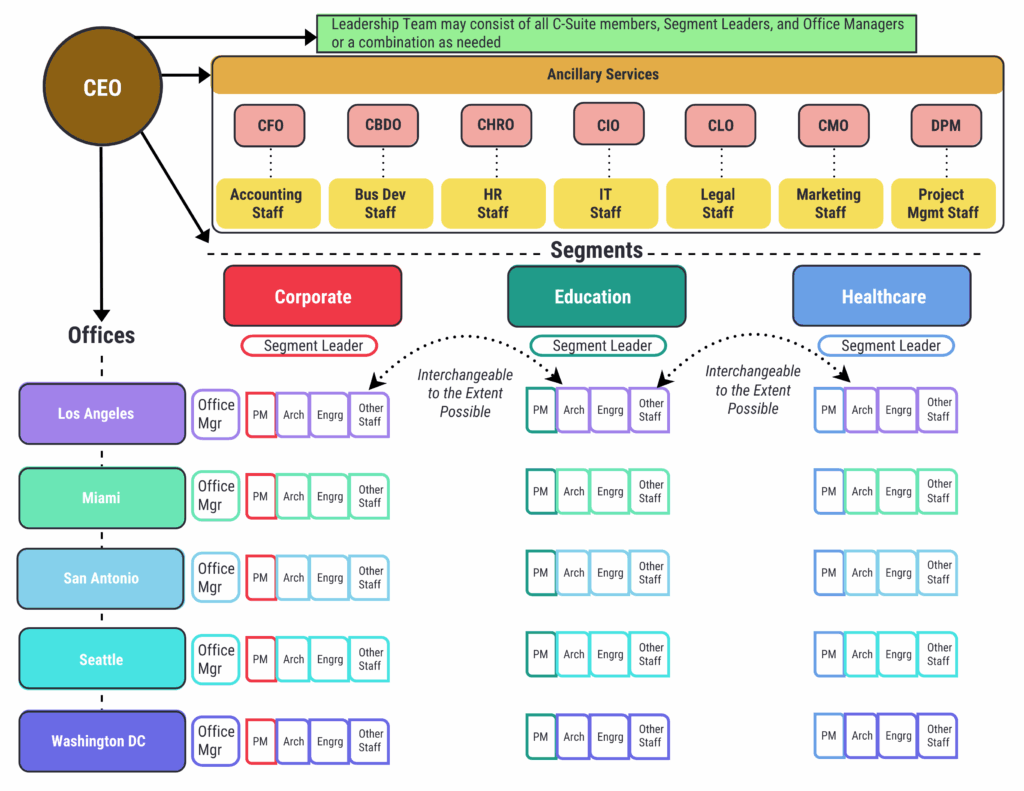
Although there is usually still only one CEO, others are called in to add their expertise for decision-making or managing changes. A group of C-Suite officers makes up the Leadership Team of the organization, with possible add-ons such as Segment or Division Heads, and/or Office Managers, as determined by the CEO to implement changes.
Problems with Matrix Organizations
The most significant problems for matrix organizations are the same things we saw with hierarchical models, but matrix organizations are even more complex, highly competitive, have confusion between departments and divisions, have multiple layers of middle managers, have difficulty communicating between the layers of management, and must contend with even slower decision-making and creating innovation than a hierarchy format.
Matrix’s dual reporting systems can create internal conflicts of interest, silos, and power struggles between different types of managers and their employees.
It’s common for matrix employees at the lower levels of the company to have two (or more!) separate managers: one at the Divisional level and one at the Departmental level. These employees suffer damage from their dual managers, including fighting over time and project prioritization, and infighting over scarce resources. They are also under project managers when they work on chargeable projects. These employees are not usually allowed to make decisions that impact their work as much as they would like because they need approval from their superiors. This slows decision-making, communication, and innovation, and creates unclear employee responsibilities.
Troubles are magnified and even more complex for multi-national organizations.
Paradigm Thinking
Before we get into comparing organizational paradigm differences, it’s worthwhile to unpack the word “paradigm.”
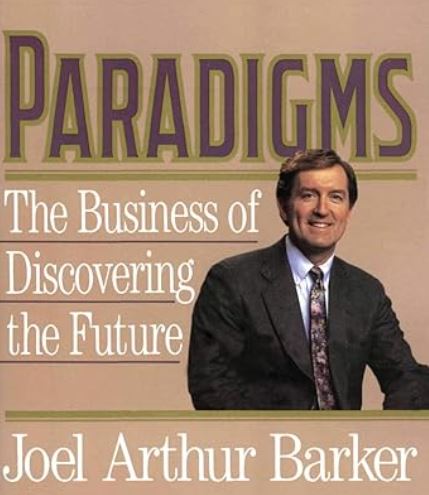
In the 1980s and 1990s, the word “paradigm” gained significant popularity due to one person: Futurist Joel Arthur Barker. Barker postulated that “paradigm shifts” in the corporate world were something that leaders could use to their advantage in finding and harnessing innovation.
The word had been used before, of course, but it was stuck in scientific discussions rather than business. Barker’s broadening of paradigm shift thinking showed how business leaders would rather hang onto their old paradigms because they were comfortable in them than explore new ones, which had the possibility of creating massive innovation. But more importantly, a new paradigm solved problems that the current paradigm couldn’t have solved.
Paradigms are of two natures: 1) the existing paradigm, where “we’ve always done it this way” reigns supreme, and 2) a new paradigm, the infusion of new energy that leads to solving old problems with new thinking.
As an existing paradigm winds down, organizations become more reactive instead of proactive; they shut down thinking to stay within their existing paradigms. Hence, the “we’ve always done it this way” thinking prevails instead of reaching for a new paradigm just around the corner, which is more beneficial.
Barker notes that “Paradigm Shifters” (those people who can spot and shift an organizational paradigm inside an existing business) can only be found in four scenarios:
1️⃣ An employee with any new degree,
2️⃣ A new employee coming aboard our ship,
3️⃣ Employees who have been on our ship for a while (years). (“Mavericks” work at the fringes of their normal departments, easily spotting new paradigms), or
4️⃣ An external person who has played around with a problem long enough to work it out, even if it has stumped others for years (a “Tinkerer”).
We can apply paradigm thinking to how humans have evolved throughout the ages. As humanity grew in its knowledge of itself, our world, and our interconnectedness, these changes also evolved our paradigms of how we worked.
What was good for us during the Middle Ages was further refined during the Renaissance to bring about new developments in capitalism, banking and globalization. And we haven’t looked back — we haven’t yearned for the days of centralized authority or feudal societies; these have grown archaic. Instead, we keep growing in our knowledge, reaching for the new paradigm, something that encapsulates all that we aspire to be in the future.

These concepts hold true for organizational models, too: new paradigms of business organizations are needed when old paradigms have become antiquated. Newer paradigms purposely set out to fix the paradigm problems that came directly before them.
It’s this aspect that we’ll examine, and where Teal Organizational Paradigm comes into play in the next article.
We’ve been stuck in business with archaic thinking. Stuck competing with and against each other. Stuck inside our existing paradigms. It’s time to blow the sides out of our existing paradigms and get ready for the next paradigm.
What would happen if everything, and everybody in your organization, were above-board, open, and if we could collectively harness all the goodness that each of us has to offer? Is that appealing to you? It sure is for me — I’ve yearned for this for decades!
Are you ready to look into the future? Stay tuned for the next article.