
This is part of a series originally created on LinkedIn, where we attempt to unpack this phrase that dismisses people needlessly. In this case, we’re unpacking the situations inside our workplaces for deeper understanding.
Although there have been numerous positive changes in the last five years, many of which have been part of the Covid-19 era shifts we’ve experienced, we may still need to focus on our organization’s capabilities to make the workplace safe enough to examine its core culture. If you’re brave enough, let’s dive in!
For the previous posts in the series, click here:
- Difficult Colleagues? Introduction to the Series
- Difficult Colleagues? Possibility 1 – Paradigm Shifters
- Difficult Colleagues? Possibility 2 – Gender Behavioral Differences
- Difficult Colleagues? Possibility 3 – Fundamental Attribution Error
- Difficult Colleagues? Possibility 4 – Conversational ‘Un’Intelligence
Our organizations’ cultures can make them unfit to address problems.
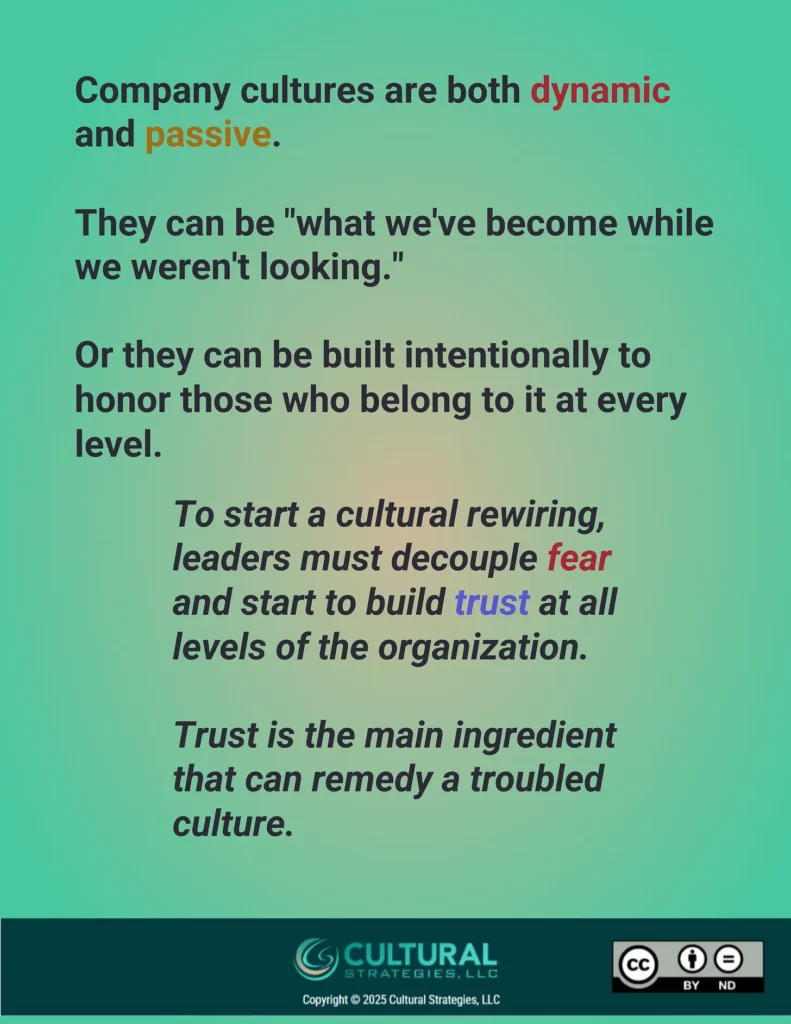
Company culture is both dynamic and passive: it is the result of past and present employees interacting on multiple levels over time. Despite the fact that an organization can intuit the need for a cultural shift, the internal culture has already been shaped and is continually fortified by many people, their beliefs and stories, and decades of interaction.
Three groups interweave in culture creation:
- The Leadership Team, usually far removed from front-line workers – they envision the “wished-for” state,
- Middle Managers, charged with turning the Leadership Team’s vision into action – they are the tactical bridge, and
- Front-Line Workers – charged with getting the work done despite problems – they are the customer-facing (internal or external) workhorses of the organization.
This 3rd level is where we see the organization’s true culture.
Since front-line workers know they must get their work done on time, they may bypass other lenses of culture change in favor of a slightly modified status quo. They see the problems between the “wished-for” vision and their reality in the trenches, but most will not bring them to their leaders for fear of reprisals or being perceived as difficult. (Ahhh – there’s the word!)
To start a cultural rewiring, leaders must decouple fear and start to build trust at all levels. Trust is the main ingredient that can remedy a culture full of blame and factions.
Employees think, “I must be able to trust you with my vulnerability, after all, I’m human and make mistakes. If I can’t trust you not to demean me, I cannot do my job well and will likely repeat my mistakes. I need your trust to do the best job.”
Managers must say, “We’ve all made mistakes and want to sincerely apologize for ours. We can’t build this business well unless we work together. Let’s figure out how to do that.”
Leadership teams are made up of humans – and humans who have a lot on their plates to navigate every day. They have “tiffs” (as one of my fellow leadership team members called them), and sometimes they have some pretty intense, knock-down, drag-out fights.
But if front-line workers and middle managers only see the tiffs and fights instead of the resolutions to them, they may think that it is not safe to bring up problems themselves in whatever realm they’re working in.
In these cases, the organization has become unfit to discuss its culture or to see a way out.
When employees feel the need to disclose a problem, they may hesitate. When they can no longer bear it, they must weigh their options: telling the truth and potentially becoming a Difficult Colleague, being dismissed, or staying silent, retaining their jobs.
Leaders can do a great deal to walk all employees through what they go through every day. Employees need to hear about the tiffs (they don’t need specifics), but they also need to hear about the resolutions. Workers need to know that everything worked out well for the relationships inside the leadership team. The best decisions were made during their decision-making process because of their ability to bring up tense topics and talk through them, allowing them to find the best solutions between polarities.
This makes our leaders more human, but also allows everyone to trust them more. And it makes us want to follow them more.
To become and remain vulnerable during culture change is difficult for any organization. We’ve been conditioned to be aware of and blame others when something goes wrong. In reality, changes and decisions were made in incremental steps, far removed from our current org charts.
This may have created a hyper-sensitive and hyper-competitive company where we focus too much on whose fault a problem was, rather than fixing it.
Unwinding this type of culture is hard, but needful if we want to get to where all of us thrive instead of just survive. It’s not impossible!
Trust must be built over time. Trust and vulnerability work hand-in-hand to create a better next phase of our organization’s culture. If we aren’t vulnerable, there’s nothing to trust.
Listening and co-creatively crafting the changes needed starts to rebuild trust. When employees, managers, and leaders become partners in shifting the culture, they create the way forward toward true positive change.
Building up our cultural muscles must happen every day. It can’t be a one-and-done effort. Failure in this can quite possibly be the largest factor that creates “Difficult Colleagues” who are really not Difficult at all, but who get removed right when we might need their thinking or expertise to help the organization.
How much time should an organization spend trying to understand “How did we get here?”
A better question is, “Here is where we are, no matter how we got here. How can we get to a better tomorrow?”
Trust must be built from the top down AND the bottom up, crisscrossing all employee levels and infusing the entire organization with good.
When we can do this, all feedback is valuable and necessary. We become more fluid in working together and richer in the culture of our organizations. We solve more problems than we make. We all succeed. And none of us are Difficult Colleagues because we rely on each other to change ourselves or to tackle unforeseen problems.