
This series was originally published on LinkedIn and Medium, where we defined the term “Teaming Behaviors,” which is in direct opposition to “Team Building.”
This is a new concept in Teaming that creates high-functioning, adept, and transformational team member success. Teams that have good Teaming Behaviors don’t get stuck in the weeds and go on to become highly exceptional and mature teams. These team members can then transition back and forth between other teams, infusing them with the same teaming skills to achieve true teaming success.
For the previous posts in the series, click here:
- Intro to Teaming Behaviors – Post 1
- Teaming Behaviors – Post 2: The Year They Discovered People – The Hawthorne Studies (1924-1932)
- Teaming Behaviors – Post 3: Tuckman’s Stages of Group Development – Where We’ve Been (1932-1977)
- Teaming Behaviors – Post 4: Tuckman’s Stages of Group Development – The Forming Stage
We’re going to enter the most misunderstood Stage of a team – The Storming Phase, 2nd on Tuckman’s list of stages.
Our Team Enters the Storming Stage – The Story Continues
Over the last few weeks, our team has experienced some problems.
They’d met in high hopes of doing good work for their organization in their initial meeting with their CEO, but as the weeks passed without subsequent meetings, apprehension grew.
Team members began to notice a critical oversight: there was no appointed leader for the team. The CEO, who wasn’t leading the team directly, hadn’t delegated this responsibility, leaving the team in limbo. [Although teams can choose a “Co-Leader” or “Leaderless” model, this only works well after the team’s cohesion in the late Norming Stage.]
The team had its second meeting only after the CEO, who had enquired of one of the team members, became frustrated by the team’s lack of progress, and urged this team member to organize a discussion to get the team back on track. This individual reluctantly became the “de facto” team leader despite lacking what they thought were the necessary qualifications of a team leader.
Additionally, old conflicts resurfaced among some former team members who are now a part of this new team, casting doubt on their ability to collaborate effectively.
Confusion also reigned regarding the project’s direction. Each member had a different vision of what they were building, leading to conflicting priorities.
These issues set the stage for the Storming Phase of the team, which is characterized by:
- Behavioral Conflicts: Personality clashes, power struggles, jealousy, and defensiveness
- Lack of Norms: Avoidance of commitment and accountability, and a lack of trust between team members
- Goal Disagreements: Differing expectations and disorganization regarding the tasks of the team
In this chaotic phase, the team’s initial camaraderie seemed to evaporate. Members became confused and defensive, splitting into factions vying for control.
Distrust and questioning of each other’s competence and motives lead to disputes over project execution. These clashes often cause disengagement, with some members thinking about leaving the team.
Despite what the CEO had planned, the team didn’t want to get stuck on a failing project or in a failing team.
Other team members thought they should lead the team, not the person the CEO had asked, so they started challenging the leader that the CEO had chosen. It became a tug-of-war for bragging rights, and the toxic culture inside the team became evident.

The Concepts inside the Storming Stage
Let’s take a look at the axes in the Storming Stage:
- Team Effectiveness against Task
- Team Behaviors inside the Stage
- New Concept – Congruency
Inside the Storming Stage
Team Effectiveness: The measurement of the team’s accomplishment of its tasks, taking into account its interpersonal relationships.
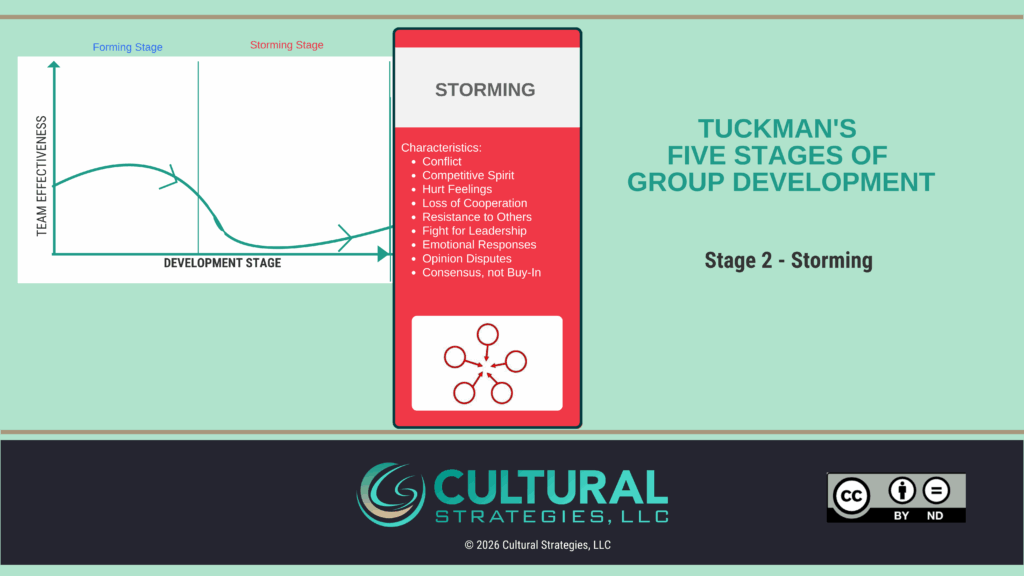
Team Behaviors inside the Stage: The Storming Phase is characterized by a rapid decline in team effectiveness compared to the Forming Stage. More energy and time are spent on internal conflicts and establishing a pecking order or arguing about how to achieve the project’s results than on actual project work.
Congruency: A team’s effectiveness is high-performing when its behaviors don’t get in the way of the team’s accomplishment of its tasks.
- High Congruence occurs when the team’s effectiveness is unhampered by the team’s behaviors. The more the team acknowledges and accepts each other and their individual skills, the better and faster it will accomplish its tasks, achieving superior success with quicker finishing times.
- Low Congruence occurs when the team’s activities are hindered by their behaviors toward one another, resulting in ineffective and problematic work. Also, the team takes substantially longer to complete its tasks due to internal friction. It also may lead to inferior final products or projects because no one is willing to bring up problematic areas that the team should have addressed before finalization.
Unfortunately, some teams linger in this stage for extended periods, sometimes years, or indefinitely, hampering their overall effectiveness.
If a team cannot find forward momentum somewhere, the team will likely fail. Frustrated team members are likely to leave the team. Some may even leave the organization altogether.
Here, it’s helpful to understand some additional terminology:
Team Fracture: When the team needs to heal from conflicts and is open to looking at its problems. Much like healing from a broken leg, several methods can be combined to help the team heal, ultimately making it stronger afterward. The team can reset itself during the Storming Stage.
Team Failure: When the team has decided to break up completely. Individuals cannot be induced to work with the people inside this team again. The Storming Stage is the end Stage of these kinds of teams.
These are the things that depict the team’s first half of the Storming Stage.
However, there is Hope…in the Very Last Portion of the Storming Stage
Recognizing a project’s lack of progress can be a pivotal moment inside a team, encouraging the team to prioritize the project over its personal conflicts and lack of project progress.
This realization can lead to a renewed focus on problem-solving, critical thinking, decision-making, and establishing new team norms. Team members begin to reflect on past issues, asking themselves, “What just happened, and how can we prevent it from happening in the future?”
Most teams experience more than one Storming Stage. However, because successful teams have developed co-created norms during the latter portion of their initial Storming Stage, they understand how to move beyond Storming in a second or third go-round by asking the right questions to further their work.
This phase is crucial for setting boundaries regarding acceptable behavior and commitment, paving the way for entering the Norming Stage.
And it is a mistake to try to avoid the Storming Stage. Teams must go through Storming to break into the Norming Stage.
As the infographic shows, team effectiveness decreases significantly in the early- and mid-stage of Storming, but starts to increase as the team prepares to fix its problems.
Teams need to analyze the issues inside their teaming experience if they are ever to move past the Storming Phase.
Issues Identification is crucial so that the team understands the exact issues it is facing. We sometimes use Daniel Kahneman’s Fast Thinking to theorize the issue in easy heuristics, attributing it to someone else’s fault, when what we need is Slow Thinking that can analyze internal issues to get to the actual core of the problem.
From this infographic, we can see some of the barriers to effective teamwork. We usually start out at the individual, Personal Barriers, assuming that our fellow teammates are the problem. But if we are truthful with ourselves, we know that the issues are deeper than this.

We must move from the outside of the circle toward the inside by identifying the actual issues. We can usually do this by using the Five Whys method to dive deeper into the circle. Asking ourselves “Why” something might be the case, five times, will usually get to the heart of the matter. This activity must be done within the entire team, assuring that more introverted team members feel safe enough to discuss their true viewpoints – a very hard thing when a team is in the Storming Stage.
Once this is done and the team is in agreement on the real issues, they can determine a way to fix the problems.
Continuing the Story of Our Team Inside the Storming Phase
Because our team is committed to the project, their CEO and organization, they are starting to see that they must come together rather than stay apart or stay at loggerheads with each other.
During the team’s second meeting, our “de facto” leader offered to step into the “real” leader’s spot so that the team could figure out its missing pieces and move forward. Even though this person didn’t feel equipped to lead, the rest of the team said they would help if needed and would not compete against each other for the leadership position.
They vowed to work together to resolve the issues that were hampering the project and their ability to work together. This includes:
- Understanding the project better, how it should function when done and the intricate pieces that needed to be built inside the application, needed to “talk to one another”
- Understand which employees should provide their specialty skills to each portion of the application build
- Determine if others need to weigh in on decisions who are not a part of the current team
- Determine the Norms of the team: how they will work together for the duration of the project

Now, they can start to feel more hopeful.